On most days, I pass through Duke’s Fitzpatrick Building between CT scans. Its hallways can be quiet enough to hear someone coming up the stairs. During the 100 Years of Innovation: Duke Graduate Research Fair, I heard voices before I reached the third floor.
A Comic Page in a Building Full of Stories
Research had filled the building. Across three floors, graduate students brought robots, models, and inventive ways to make their work visible, tactile, and inviting. Presenters wandered over to see one another’s displays while waiting for judges to visit their own. I was amazed by the creativity of my peers and by how much there was to discover just by walking from one station to the next.
I had brought barnacles, X rays, and a comic book superhero.
From One Slide to a Comic Page
For Duke’s Three Minute Thesis competition, I created a single slide styled like a superhero comic. It introduced the cast of my research: barnacles that build shells and glue, plastics with properties that can affect living things, and a version of me with X ray vision.
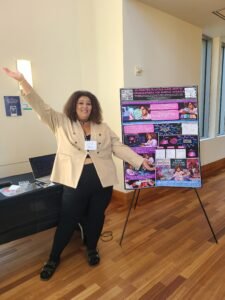
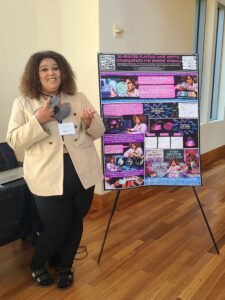
The research fair asked for something different. Instead of guiding an audience through the story in three minutes, I needed a display people could approach and explore for themselves. I scaled my 3MT graphic into a poster that looked more like a comic page than a traditional research poster.
The superhero in her pink lab coat was still there. So were the barnacles and the rainbow of color that helps me show what invisible X rays reveal. This time, though, the page had more room for the question behind the story: what happens inside a marine animal when it grows on a new material?
The Barnacles Beyond the Page
I set up a station beside the poster with 3D models, actual barnacles, calipers, and video renderings of my CT scans. Visitors could see the animals, the tools I use to measure them, and the shell structures that are usually hidden from view.
In this research, we grew barnacles on four 3D printed plastics, PLA, ABS, nylon, and TPU, and compared them with barnacles grown on glass. We measured their growth over time, then used microcomputed tomography to look inside their shells without breaking them open.
One finding stayed at the center of my display. Barnacles grown on PLA could look much like those grown on glass from the outside. Inside, their shells were thinner and had less volume.
It was rewarding to move between the comic and the real things it represented. A visitor might notice the superhero first, then pick up a model, look at a barnacle, and watch a scan turn a shell into a landscape of hidden details. The poster opened the conversation. The station gave us somewhere to go with it.
A Place to Pause
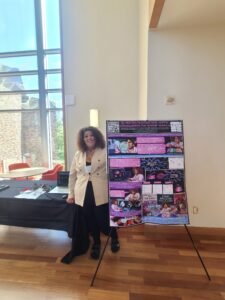
My display was on the third floor, just to the right of the elevator and against a giant window. Beautiful light fell across the poster and the table.
The spot sat between the main atrium and a corridor leading into a series of hallways and labs. People attending the fair came through, but so did students traveling to and from class. Some were on their way somewhere else when the comic caught their eye.
I loved that. The fair was designed to welcome people beyond our individual fields, and my station stood in a place where someone could stop without having planned to learn anything about barnacles. A question about the artwork could become a question about the scans. A glance at the models could become a conversation about plastic in the ocean.
A Different Kind of Energy
I was preparing for the fair while also running CT scans for my dissertation, moving between the event and the work that had brought me there. I knew the quieter version of Fitzpatrick well. Its hallways had often given me a place to pause between scans.
That afternoon, the building felt entirely different. Footsteps mingled with conversation. Students carried their excitement from one floor to another. Presenters stepped away from their stations to admire a peer’s work, then hurried back when a judge arrived.
The quiet refuge had become a place where research spilled out of the labs and into the hallways.
I arrived with a comic page about seeing what is hidden inside barnacles. I left thinking about all the ways my peers had made their own work visible, too. For a few hours, three floors of Fitzpatrick offered a glimpse into the questions being asked all around us, and gave anyone passing through a chance to stop and look closer.