 If you could have one superpower, what would it be?
For Duke’s Three Minute Thesis competition, I chose X ray vision. Not the kind that sees through walls, but the kind that lets me look inside a barnacle without breaking it open. With microcomputed tomography, I can see the tiny structures it builds beneath its shell, including changes that might otherwise remain hidden.
That became the opening of my presentation. It was not where the story began.
Finding My Jingle
Three minutes is just enough time to tell someone what you do. It is not enough time to explain everything you know about it.
While I was working on my presentation, my advisor Dan suggested organizing it like “Her Name Was Lola,” the Barry Manilow song, Copacabana. I could not see what a barnacle, a plastic surface, and Lola had in common.
Eventually, I realized he meant I needed a jingle. Something that would stay with the audience and give the story a shape they could follow.
Mine was superpowers.
Barnacles have them. They build skeletons and make glue that holds them to rocks, docks, boats, and plastic. Plastics have them, too. The properties that make a material durable, flexible, compostable, or printable can also change how it interacts with living things. My collaborators bring their own powers to the work. And I have X rays.
Once I found that idea, I began seeing the presentation differently. I was not simply trying to fit my research into three minutes. I was inviting people into its world.
A Coach in My Corner
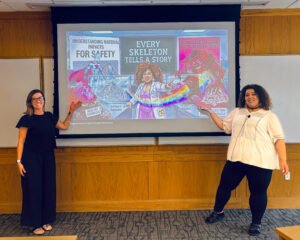
Allison, my 3MT coach, helped me think about what it would take to bring an audience into that world. Her mentorship pushed me to look beyond the facts I wanted to include and consider what someone hearing this research for the first time might picture, wonder, or remember.
I could tell an audience that a barnacle on glass and a barnacle on 3D printed plastic look nearly identical from the outside. Or I could let them borrow my X ray vision and discover the difference with me.
Inside, the story changes. The barnacle on plastic has a thinner skeleton, an altered foundation, and weaker glue. Those details are visible in my scans, but Allison helped me see how to make their meaning visible, too.
The science did not need to become less precise to become more engaging. I needed to find a way to let people see why it mattered.
Between the Lab and the Stage
Preparing for 3MT happened alongside the work itself. I was still in the lab, finishing CT scans for my dissertation in a room kept ice cold so the enormous instrumentation would not overheat. I would come out tired but wide awake, carrying images of tiny skeletons and rehearsing how to explain them in three minutes.
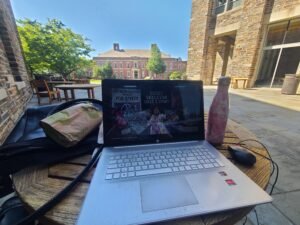
Then I would take my coffee outside.
North Carolina’s humidity felt especially thick after the scan room, but I welcomed it. The warmth settled around me while I sat with my script, trying out words and letting my thoughts slow down. Inside, everything was cold, bright, and precise. Outside, I could relax enough to hear how the story sounded.
I went back and forth between those two spaces as I prepared: gathering evidence in one, finding a way to share it in the other.
One Slide, a Whole Comic Book World
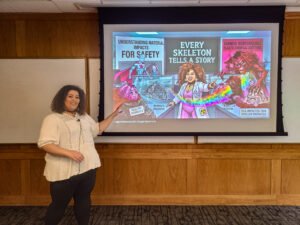
The rules allowed one static slide. I made mine a superhero comic.
AI helped me build a version of Brittney as a superhero, dressed in a lab coat that proudly announced her PhD candidate status. She wore pink, my favorite functional color. Across the image, plastic leachates became a monster looming over a barnacle that appeared to melt. On the other side stood a healthy barnacle.
Between them ran a rainbow.
That rainbow represents pseudocolor, one of the ways I illuminate differences revealed by invisible X rays. The scans give me information I could not see from the surface; color helps me show someone else what I have found.
There is a little secret in the rainbow, too. Hidden within it are skeletons of other organisms I study, including fish. The slide told the barnacles’ story, but it left traces of a larger research world for anyone who looked closely enough.
Making the image was another exercise in communication. I had one frame, so every detail had to help tell the story. The comic did not replace the research. It gave the audience a way in.
What I Took From the Stage
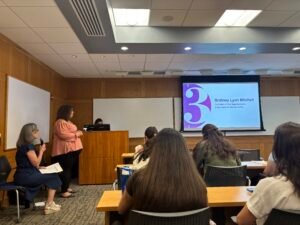
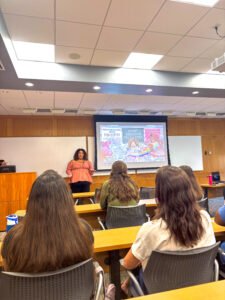
I presented at Duke’s 3MT, but I did not advance to the finals. I am still glad I stepped onto that stage.
I came away with a story I would not have told this way before, a superhero version of myself in a pink lab coat, and a deeper appreciation for the mentorship that helped me find both. Allison helped me see that sharing science is not only about making difficult ideas simpler. It is also about noticing what might spark someone’s curiosity and giving them a reason to look closer.
My X rays let me find stories hidden inside skeletons. Three minutes taught me to think differently about how to share them.